 MENTAL PENGUIN
The Two Lids
A tale of the golden ratfolk of the Greywood · original fiction set in the world of Banners & Legends.
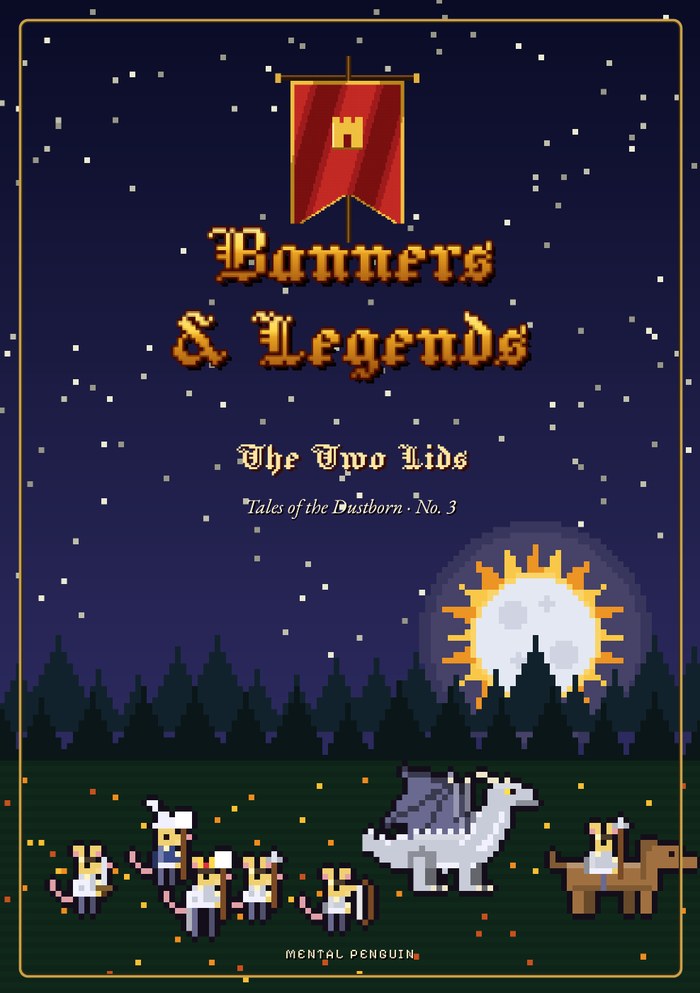
Tansy, Mother Saffron, Sergeant Burr and the Greywood are invented for this story. The Fellowship of the Silver Moon is real: you can summon them in the game.
The Two Lids, as a 30-second Short. Watch on YouTube
In the middle of the Greywood, where the trees grew so close that daylight had to ask permission, there was a glade, and in the glade there was a stone, and on the stone, once a month, the moon came down to drink.
That, at least, was how the Fellowship of the Silver Moon told it.
They were ratfolk, but not the ordinary brown kind that lived in other people’s cellars and other people’s stories. They were golden. Their fur shone like old coins in candlelight, their whiskers caught the faintest gleam, and their eyes were so sharp that a Fellowship scout on a high branch could count the buttons on a traveller’s coat from half a league away, and tell you which one was loose.
They knew a great many things about the moon. They knew, for instance, that it was a flower.
“Look at it,” Mother Saffron would say, on the nights it rose full over the glade. She was the Hierophant of the Fellowship, very old, very small, and wrapped in so many robes that the novices bet on how many. “Round. Pale. Opening in the dark. What else could it be but a marigold?”
“It’s silver, Mother,” a novice would point out, every year, because every year there was a new novice.
“Because it’s far away,” Mother Saffron would reply. “Everything goes silver when it’s far away. Even your manners, apparently.”
And so the Fellowship called the moon the Marigold, and they grew marigolds of their own in every clearing of the Greywood: orange and gold and the deep rusty red of old embers, so that from above, the forest looked as if someone had spilled a jar of sunset in it.
Tansy was the youngest petal-gatherer in the Fellowship, which meant she gathered petals, mostly, and was told off, mostly.
Her job was simple. Each day she picked marigold petals into a basket. Each evening she brought the basket to the Stillroom, a hollow under the roots of the oldest oak, where Sister Rue the Moon Witch kept her jars.
There were two kinds of jar in the Stillroom. There were jars with silver lids, and jars with black lids.
“Petals steeped under the full Marigold,” Sister Rue had explained on Tansy’s first day, tapping a silver lid, “make the Light. One drop on a wound and it closes. One spoonful in a fever and it breaks.” She tapped a black lid. “Petals steeped in the dark of the moon make the Sting. One drop on a blade and the blade remembers you.”
“But it’s the same flower,” Tansy had said.
“It’s the same flower,” Sister Rue agreed. “The same petals. The same hands. The only difference is when you pick them, and how you mean them.” She put both jars on the highest shelf, side by side. “Know which lid you’re reaching for, and why, child. That is the whole of the law.”
Tansy thought it was a very short law, as laws went. She said so. She was given extra petals.
It was Tansy who saw them first. Of course it was: she was the one in the tallest tree, pretending to gather petals that did not grow there.
At the very edge of the Greywood, where the forest gave up and became farmland, a line of smoke was rising. Under the smoke there were horses: big, armoured horses with ribbons on their bridles. And over the horses there were banners, blue and gold, with a crown on them that Tansy didn’t recognise, because the Fellowship had never needed to recognise anyone’s crown.
She counted. Forty riders. Twice as many on foot. A wagon with a cage on it. A herald out in front with a trumpet and a scroll.
The wind was blowing towards her, and her ears were nearly as good as her eyes.
“By order of the Crown,” the herald was shouting at a confused-looking goat, “the Greywood is declared a nest of plague and VERMIN. All vermin within are to be cleared by fire and by sword, for the safety of the realm. Long live the King.”
The goat said nothing. Tansy came down the tree so fast she left a petal-shaped dent in the moss.
The council met in the glade that night, under a moon that was only half open.
“Vermin,” said Sergeant Burr, as if the word tasted of soap. He was the captain of the Moon Blades, the Fellowship’s swordsrats, a scarred old veteran with a notch in one ear and three faded stars stitched on his sash: one for every battle he had walked out of that the others hadn’t. “They’ve come to burn us out of our own wood because somebody told them rats spread plague.”
“Do we?” asked a novice.
“Not on purpose,” said Sergeant Burr.
“Let them come.” That was one of the Elk Riders, a young buck called Fennel, who had never been in a battle and talked about them a great deal. “We know every root in this wood. We’ll hit them from the trees, and every blade will carry the Sting.”
The Moon Drake, which slept in the lightning-struck tree at the far side of the glade and ate nothing but moths, was not mentioned. Nobody dared wake it.
There was a murmur of agreement. Everyone looked at the highest shelf of the Stillroom, which you could see from the glade if you knew where to look. Everyone looked at the black lids.
Mother Saffron raised one small golden paw, and the glade went quiet.
“We are the Fellowship of the Silver Moon,” she said. “We have two jars. Which one we open depends on how they come to us.” She turned her old, bright eyes on Sergeant Burr. “Not on how frightened we are of them.”
“They’re coming with fire, Mother,” said Burr.
“Then we shall see,” said Mother Saffron, “whether they come with anything else. Until I say otherwise, the black lids stay on the shelf.”
Sister Rue said nothing at all. She just went on stirring a pot, very slowly, and Tansy noticed she had brought one jar of each.
Tansy was sent out at dawn to watch the road, because her eyes were the best and her opinions were the least wanted.
She did not stay on the road. She followed a smell instead: the sharp, sour smell of fever, coming from a gully where a stream ran under the brambles.
At the bottom of the gully lay a horse, dead, with BRAMBLE stitched on its saddlecloth, and under the horse lay a boy.
He was human, perhaps fourteen, with a squire’s tabard torn half off and one leg pinned beneath the saddle. His face was grey and wet. His breath rattled like dry seeds in a gourd. A water skin lay by his hand, empty, and next to it a little pool of the brown marsh water he must have drunk from when the skin ran out.
Tansy stood very still for a long time.
She had a satchel. In the satchel, because she was a petal-gatherer and petal-gatherers carried what they were given, there were two small bottles from the Stillroom. One had a silver lid. One had a black lid.
Vermin, the herald had shouted. By fire and by sword.
The boy opened his eyes and looked straight at her. He did not look like someone who had come with fire. He looked like someone who had been told he was going on an adventure and had found out, too late, that adventures mostly happen to other people’s legs.
“Oh,” he whispered. “You’re gold.”
Know which lid you’re reaching for, and why. Tansy had thought it a very short law. It was getting longer.
Tansy took out the bottle with the silver lid.
It took most of the morning. She dug the leg free with a stick and her own two paws, and she put a drop of the Light on the wound, and three in his mouth for the fever, and she sat with him while it broke. By noon he could sit up. By the middle of the afternoon he could talk, and once he started, he didn’t stop.
His name was Will. He was squire to Sir Grisel of the Blue Tower, who led the riders on the road. And there was, Will said, a plague, a real one, but it wasn’t in the Greywood.
“It’s in the camp,” he said. “Half the men are sick. It started after we drank from the marsh. Sir Grisel says the rats brought it, because rats bring plague. Everyone knows that. That’s why we came to burn the wood.”
“Did you see any rats,” Tansy asked, “before you drank from the marsh?”
Will thought about it. His face did something complicated.
“No,” he said slowly. “No, we didn’t.”
They came at dusk, as Sergeant Burr had said they would, with torches.
Tansy was still running back through the trees, half carrying Will, when she heard the first trumpet. By the time they reached the edge of the glade, the battle had already found its shape.
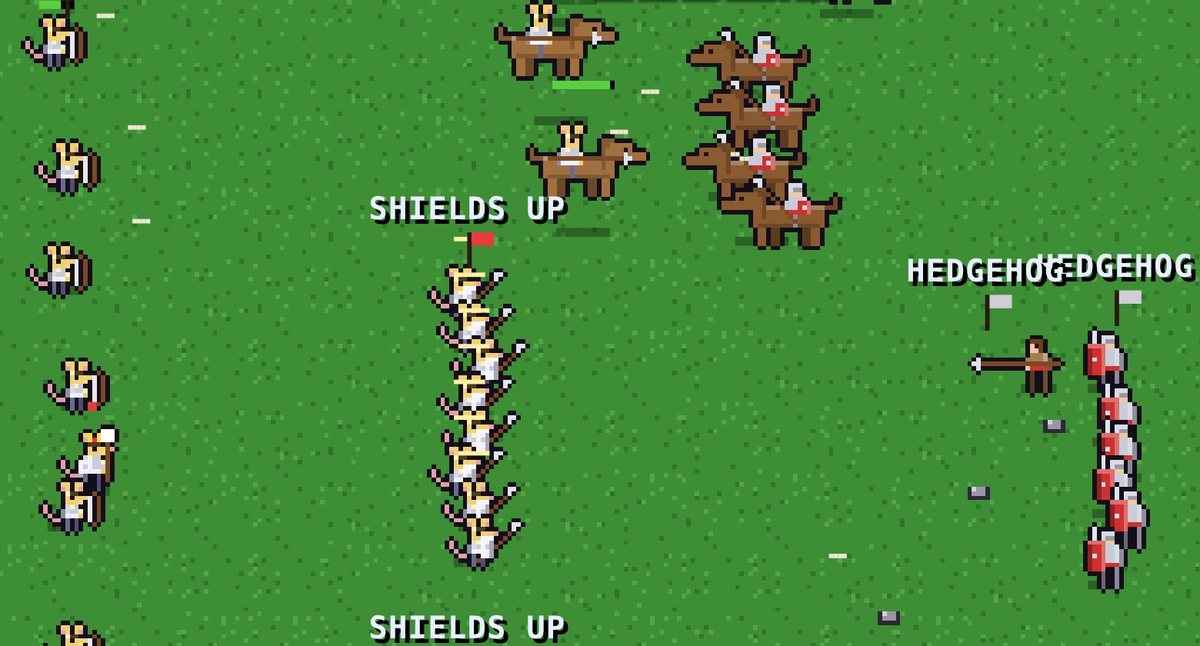
The knights had come in a long line through the trees, the way knights do, because they had been taught to fight in fields and had never been told that forests disagree. The Moon Blades met them at the edge of the glade, shield to shield, with Sergeant Burr in the centre bellowing “Hold here! HOLD HERE!” in a voice that seemed far too big for a rat. Behind them the Fellowship’s archers loosed from the branches, and every arrow that came down was plain wood and honest iron, because Mother Saffron had said so, and Mother Saffron was not argued with twice.
The horses hated the forest. They hated it more when the Elk Riders came out of the dark on their flanks, Fennel at the front, looking considerably less keen on battles than he had the night before but riding into one anyway, which is what courage actually is.
Then the knights’ torches caught the edge of the marigold beds, and the smoke rose, and Sister Rue stepped out of the Stillroom with her staff and called down the Marigold.
It wasn’t the whole moon, of course. It was only a little of its light, gathered and thrown. But it struck the leading knight like a hammer made of morning, and he went over backwards with his armour smoking, and for a moment the whole line stopped to stare.
That was when the Moon Drake woke up.
Nobody in the Fellowship was entirely sure where the Moon Drake had come from. It was pale as frost and about the size of a barn, and when it was disturbed it made a noise like every nightmare you ever had, played at once on a broken organ.
It was disturbed now. It made the noise.
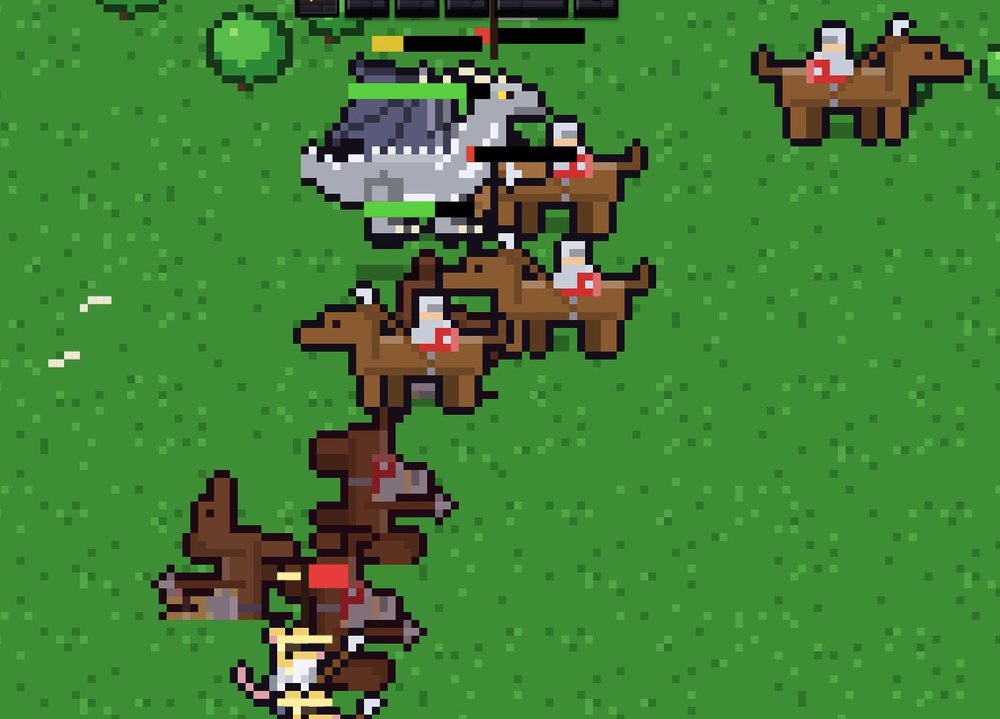
Every horse in the Blue Tower’s army decided, as one horse, that it had urgent business elsewhere. Several knights went with them. Sir Grisel’s horse took a different view and simply sat down, and Sir Grisel slid off the back of it into the marigolds, where Sergeant Burr’s sword arrived at his throat a moment later.
“Yield,” said Burr.
Sir Grisel looked up at the golden rat with the notched ear and the three stars on his sash, and the blade at his neck, which every story in the Blue Tower said was dipped in poison.
“You’re going to poison me,” he said, “like you poisoned my men.”
“STOP!”
Everyone turned. Will was standing at the edge of the glade, on two good legs, with Tansy at his side.
“They didn’t poison anyone!” Will shouted. “It was the marsh water! Look at me. My leg was crushed under Bramble and I had the fever. She found me.” He pointed at Tansy. “She had two bottles. She chose the right one.”
It took a while to sort out. These things always do.
Sir Grisel did not believe it at first, because he had believed the other thing for so long that it had worn a groove in him. But Will was walking. And when Mother Saffron came down the steps of the Stillroom, very small and very old and wrapped in an unknowable number of robes, and held out a basket of silver-lidded jars, Sir Grisel found that he did not have anything to say.
“There are sixty sick men in your camp,” Mother Saffron said. “We have Light for every one of them, and a jar to spare. Your herald may keep his trumpet, but I’d prefer he kept it closed.”
Sergeant Burr lowered his blade, wiped it carefully on the grass, and sheathed it. He looked at Tansy for a long moment, then gave her the smallest nod that has ever passed between a captain and a novice. Tansy felt it all the way down to her tail.
The Fellowship went to the knights’ camp that same night: Moon Witches with jars, novices with baskets, Elk Riders with blankets, and Fennel, who insisted on telling everyone how frightening the battle had been for the enemy. By morning the fevers had broken. By the end of the week the Blue Tower’s banners were going home, the wagon with the cage on it carrying a crate of silver-lidded jars instead of the proof Sir Grisel had come to collect, and the herald had a new scroll. The Moon Drake went back to its tree and its moths, and nobody in the Greywood had ever been so pleased to see a moth.
Tansy never read it. Will told her later that it was very long, and that the Greywood was no longer marked on the Crown’s maps as Nest of Vermin. It was marked, in small careful letters, Here Be Friends. Do Not Drink the Marsh Water.
On the night of the next full moon, Tansy sat on the highest branch of the tallest tree and watched the Marigold rise.
Below her, the beds were blooming again where the torches had burned them. Sister Rue was setting out the silver-lidded jars on the stone in the glade, ready for the moonlight. The black-lidded jars stayed on the shelf, side by side with the others, exactly where they belonged.
“It’s silver,” said a voice beside her. Sergeant Burr had climbed up, which was a surprising thing for a rat with his knees to do.
“Because it’s far away,” said Tansy. “Everything goes silver when it’s far away.”
Burr laughed, a short, rusty sound that clearly didn’t get much use. They sat together for a while in the moonlight, two golden rats on a branch, watching the flower open over the Greywood.
“Two lids,” Burr said at last. “Same flower. Same hands.” He shook his head. “I’d have opened the black one, you know. Down in that gully. I’d have been sure I was right.”
“I nearly did,” said Tansy. “Then he looked at me.”
“And?”
Tansy thought about it.
“And he didn’t look like fire,” she said. “He looked like someone who needed the other jar.”
High above them, the Marigold opened all the way. It was silver, and it was gold, and, depending entirely on how you came to it, it was both.
Meet the Fellowship
Banners & Legends rolls a fresh set of Dustborn peoples for every world: forty folk crossed with strange bloodlines, over two million in all. Golden ratfolk are one of them: forest-born, sharp-eyed, holy and venomous at once, and since update 1.3.2 every ratfolk people has proper rat ears and a long pink tail.
Want to lead them yourself? On the main menu, open 🎲 Roll a people, type this word into the box and tap Summon:
MARIGOLD
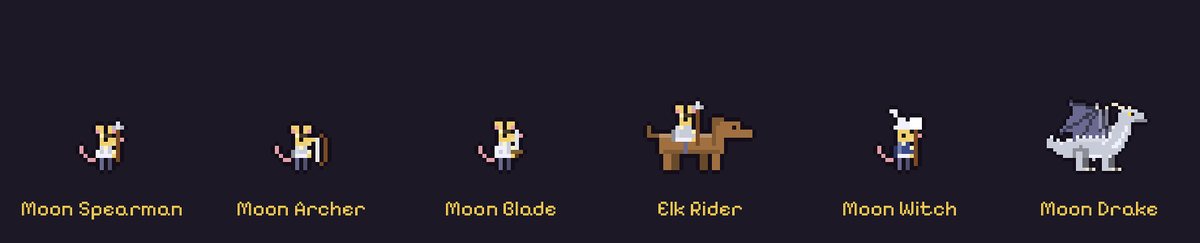
The Fellowship of the Silver Moon will answer: Moon Witches, Elk Riders, Moon Blades and the Moon Drake itself.
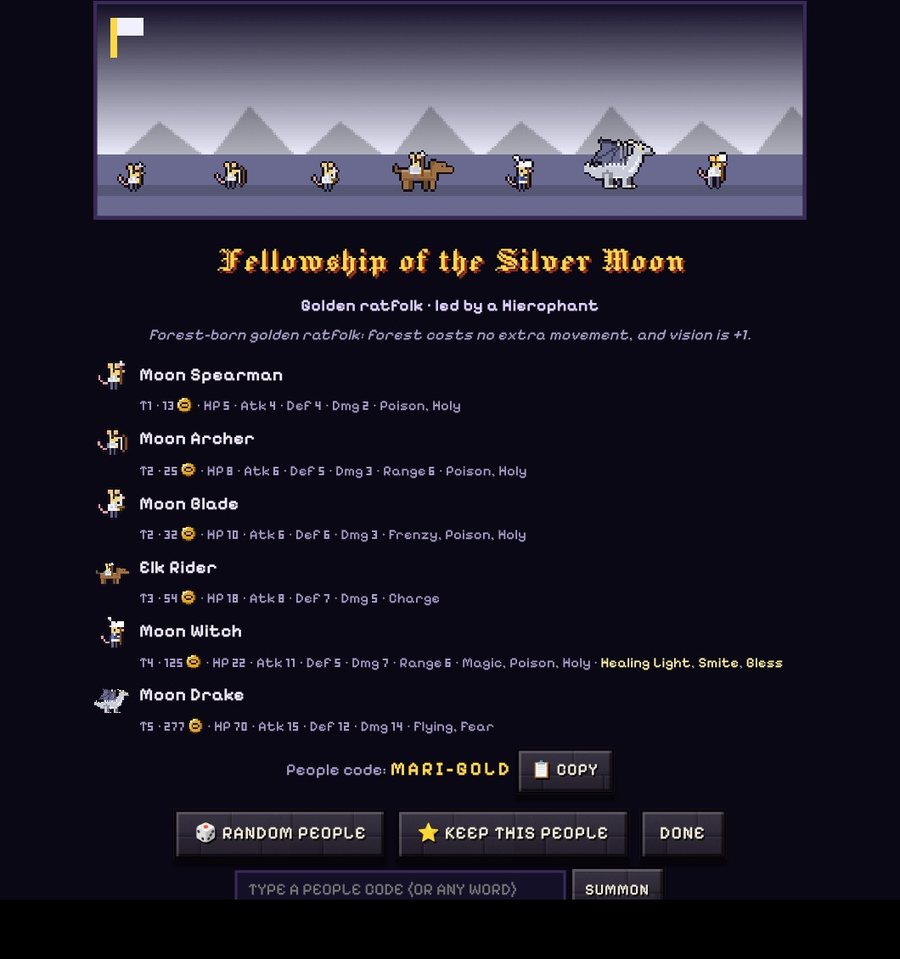
In the full game, tap ⭐ Keep this people, then choose them in a player’s faction list when you forge a new world. The free demo lets you summon them too.
Recruiting the Fellowship
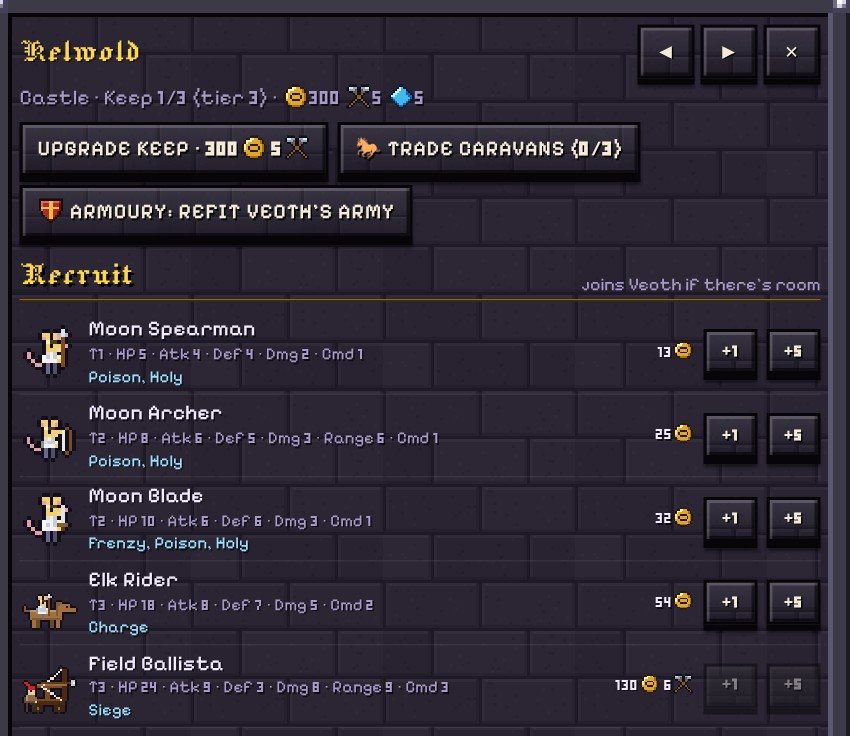
Their Moon Witches cast Healing Light, Smite and Bless. Their spears, arrows and blades are both holy and poisoned. And their sharp eyes see one tile further than most. Try them against an undead neighbour.
The illustrated PDF is a free download for everyone, and it is also in the Extras folder of the full game download on itch.io.